
FREE “Frosty the Snowman” Lesson
 My 2-year-old daughter (and Maryellen’s granddaughter), Casey, loves to watch an old VHS tape of Frosty the Snowman at her grandparents’ house. She gets frustrated when the tape has to be rewound, since she was born into the “magic” of the YouTube and OnDemand era!! She recently got the Golden Book of Frosty and says, “Mommy, can we read Charlie the Snowman?” (I think she gets the name confused with “A Charlie Brown Christmas”!) Reading it with her and singing the Frosty song, which tells the story, reminded me of a lesson that we had posted 10 years ago...


“Featuring” Expression of Feelings Using Feeling-Frames
 During Maryellen’s last two webinars, Story Grammar Marker: 2 Key Things That Set It Apart and 5 Elements of the Critical Thinking Triangle in Action!, she used a feeling-frame with the boys who participated in the lesson to highlight how characters were feeling and what they were thinking in the story, Those Shoes by Maribeth Boltz. The frames have been particularly motivating with students. They can be easily made using tongue depressors and popsicle sticks. Craft stores carry colorful ones in various sizes. We have found the easiest way to hold them together is with glue dots, also available in craft stores. These activities would go nicely with our new product, The Critical Thinking Triangle in Action! and are very adaptable to students and materials!


Reinforcing The Critical Thinking Triangle in a Chapter Book
 Students and I were recently discussing if anyone could really be “perfect.” I was reminded of Be A Perfect Person In Just Three Days! by Stephen Manes. This book was originally published in 1982 and remained a favorite read aloud of mine for many years. As I began to use the Story Grammar Marker®, this selection provided a concrete example of using the SGM® with a chapter book. It is the perfect match for a Complete Episode. From the very obvious Kick-Off to the lesson learned at the end, the book was an entertaining, fun read-aloud for students in grades 3 and 4. We have outlined the book as a Complete Episode— expand on it as you wish. Each Attempt could also be mapped out as a Complete Episode...


Tech Tuesday: Spooky Stories!
 Halloween and the days around it open up a world of strange and fun stories! Check out these apps to provide a doorway (a creaky one) to developing narrative language. Toontastic (free for iPad) is a fantastic app for all seasons and contexts, but be sure to beware of its Halloween theme! Toontastic is a screen-recording application in which you can select a Setting (or use one of your photos as a background), choose “toys” that include Characters and props, and then create a story. The app scaffolds a “plot mountain” with setup, conflict, etc., but you can use it to create simpler projects. Toontastic includes Settings such as Dracula’s castle, Dr. Crankenstein’s Lab, a spooky graveyard and house, a dark bog, and corresponding Characters to build a story. Once you select a Setting and Characters, tap Start, and the app will record both your movement of the Characters and any language spoken...


High Stakes Test Results: An Opportunity for Collaboration Using SGM
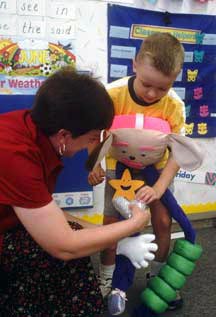 After receiving many positive comments regarding a recent post, Using Data Collection and Collaboration to Enhance Instruction, I wanted to share two other ideas that you may find helpful when first using the SGM® in your school. If you are not using the SGM® school-wide, then try working with a colleague as the SGM® is the perfect vehicle to establish collaboration and a common language around student comprehension questions and the thought processes involved in answering those questions...


Tech Tuesday: Build a Story with LEGO, Part 2
 In last month’s Tech Tuesday post, we discussed the potential of LEGO® products in interventions for social cognition and language development. The post focused on the uses of real, hands-on LEGOs for building stories, specifically, using baseplates to collaboratively build a Setting with minifigure characters, with blocks setting the stage for discussion of Actions, Kick-Offs, and Reactions. At the same time, multifunction LEGO blocks provide students with opportunities to apply the Social Thinking® concepts of “sharing imagination” and “adding thoughts” as they build together. In this post, let’s look at some (mostly) tech-based opportunities to capitalize on students’ interest in LEGO....