
MindWing Concepts Blog


“Maui” of Disney’s Moana: Using Story Grammar Marker® with Legends
 In this blog post, we share with you a children’s book called Maui Hooks the Islands with a narrative analysis, a legend written in 1700 AD, a Disney Moana song, and lesson ideas that we showed at our workshop participants in Hawai'i. The first couple of weeks of September marked the third time that Maryellen and I have traveled to Hawai’i to provide professional development for Speech-Language Pathologists, pre-K, Kindergarten, and First Grade teachers and special educators in the Hawai'i State Department of Education. Through these experiences, we have grown to love the rich culture, breathtaking landscapes, water and sunsets, and especially, the people of Hawai'i. My 5-year-old daughter Casey has made each trip to Hawai’i with us, and the first time we came, she was enthralled with Disney’s Moana (hoping to meet her in person!). In order to kick off our workshops, we wanted to learn more about the Polynesian culture that this movie depicts...


When No One There Is Like You: Exploring Feelings & “Belonging” with SGM
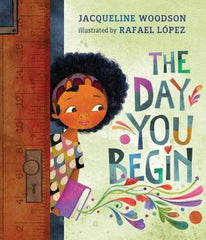 The Day You Begin, by Jacqueline Woodson and illustrated by Rafael Lopez, is a beautiful, nonlinear story to share with children, especially at the beginning of the school year. It encourages children to think about their feelings when entering new situations and creates an opportunity for teachers to provide a discussion with and to show support of children in such situations. Before sharing the selection, take a look at the following links for background information. This book is actually a story of a girl named Angelina, included with examples and guiding suggestions for fitting in, with which all of us can identify. Included below is also a link to the illustrator’s website, Rafael Lopez, discussing the development of the artwork for this book, which older students would find interesting...


Tech Tuesday/Summer Study Series: Narrative and Autism Spectrum Disorder
 I am frequently asked to conduct evaluations encompassing social cognition and pragmatic language and always find it extremely valuable to include a detailed assessment of narrative language. However, in doing so, and having reviewed previous assessments of these students, I often find that I am like a newcomer to a desert landmark, standing there saying “Hey, look at this…?” Why haven’t the examiners before me documented and then suggested interventions around these inevitably present narrative language issues?...


Character Development, Six-Second-Stories™ and Jojo Siwa
 This past week my 5-year-old daughter Casey went to camp. On the first day, I suggested that she wear a T-shirt that depicts something she likes (LOL: Dolls, Unicorns, JoJo Siwa, Mermaids, Teenage Mutant Ninja Turtles, etc.) so that when she is meeting new friends, they can immediately know something she likes and ask her about it. She chose a T-shirt with a picture of “JoJo Siwa,” who is a young, popular performer. By wearing that, new friends will know a little about her as a “character” in a social setting. Upon arriving at camp, within 30 seconds, a Dad and daughter walked in and the Dad said, “You like Jojo Siwa? Avery and her mom saw Jojo Siwa in a concert this summer!”...


A POPCORN Lesson: “CORNY” Humor, Facts and Perspective Taking with SGM® and ThemeMaker®
 I saw this meme on Facebook recently and cracked up laughing at the “corny” humor! It just so happened that it was a 95-degree day here and I felt just like that popped stalk of popcorn—SO HOT! I am sure many of you can relate to the weather this summer. I actually Googled to see if that could actually happen—that popcorn would “pop” while still on the “ear.” First, I found a website Popcorn.org and realized there is WAY more to popcorn than I ever realized! Then, while using the Description Map from the ThemeMaker® Manual, I learned so much about popcorn. Popcorn is actually a member of the grass family—a specific kind of maize (corn)...


Braidy® Activities Using Farm and Farm Animal Books - Summertime favorites!
 Today I visited the Sixteen Acres Library in Springfield, MA. As I was browsing in the children’s section, I turned to find three youngsters reading a big book, “Big Red Barn,” written by Margaret Wise Brown. We have a farm-related blog on our website using this book that you can find here. The blog includes a wonderful downloadable activity you may be interested in sharing with your students about the farm. On a table of featured books, I then found “The Cow Who Climbed A Tree” by Gemma Merino. To continue with the farm theme, I checked out this book and thought you may enjoy sharing it with your students...