



April 24, 2020: Final Lesson Ideas for Settings, FB Live

Last of 3-Day Lesson Ideas for Settings: When choosing Big Red Barn as a follow-up to the “At the Farm” assigned passage, my purpose–as a parent at home–was to use the book to elaborate on the topic that was presented in the assigned passage, as a teacher may do in school. I wasn’t worried about lexiles. I wanted a book that would appeal to a child in kindergarten to read for fun and maybe to teach a few things. When looking through Big Red Barn I found many elaborations!


April 23, 2020: More On Settings, FB Live

Lesson Outcome: After completing this sequence, you will have expanded the initial lesson “At the Farm” provided for the student. Furthermore, you will have learned how to differentiate a lesson for children of different abilities. Also, you will have noticed that there are many levels within the activity: there will be some students who are able to tell a personal narrative readily. At the same time, there will be students who are at the stage of assembling the animals in order and putting them into the “barn.” Both children are learning the “personal narrative sequence” and will progress at their own pace...


April 22, 2020: More About Settings, FB Live
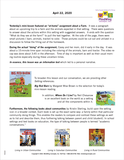
To broaden this lesson about settings and our conversation about a farm, we are providing other setting references: Big Red Barn by Margaret Wise Brown is the selection for today’s mini-lesson reading. Other suggestions are provided in the handout...


April 20, 2020: COVID19 Uncertain Times, FB Live
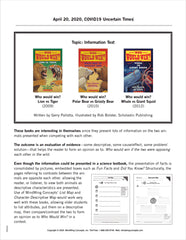
The “Who Would Win…” books are interesting in themselves since they present lots of information on the two animals presented when competing with each other. The outcome is an evaluation of evidence—some descriptive, some cause/effect, some problem/solution—that helps the reader to form an opinion as to: Who would win, it the two were opposing each other in the wild. Even though the information could be presented in a science text book, the presentation of facts is consolidated by pictures, embedded boxes such as Fun Facts and Did You Know? Structurally, the pages referring to contrasts between the animals are opposite each other, allowing the reader, or listener, to view both animals as descriptive...


April 9, 2020, Amid the COVID19 Pandemic, FB Live
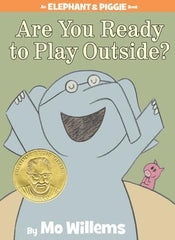 Today I want to show how authors always include information in their stories. We should look for it as we read. For instance, the information for the setting is a time and a place…BUT…what is happening at that time in that place is the important part for a story! The timing of a kick-off and how characters in the setting respond to the kick-off through feelings, thoughts, words and actions is finalized when the character makes a plan. How things turn out as a consequence depends on the actions (attempts) to carry out the plan and whether the plan is realized. I used the book, Are You Ready To Play Outside? by Mo Willems. This book is part of a series starring Gerald the Elephant and Piggy, the pig! I noted in my mini-lesson that you might want to look at this book for the concept that kick-offs (the rain) often occur gradually in many situations...