


“Hilda Must Be Dancing” and “Giraffes Can’t Dance” — Narrative Retellings
 These lessons would occur over a period of several days. I usually begin with Hilda Must Be Dancing, but it doesn’t matter which story you choose to work on first.
Read the story to the children. Present a map to the children of a complete episode with the icons going down the center. You may use either chart paper or use the magnets on a white board, as shown.
After reading one of the stories, map it out, icon by icon, engaging the children in the process. After reading one of the stories, map it out, icon by icon, engaging the children in the process. Keep the chart up and model retelling the story using your SGM® Teacher Marker…


Early Elementary Idea to Reinforce Character, Feelings, List and Sequence
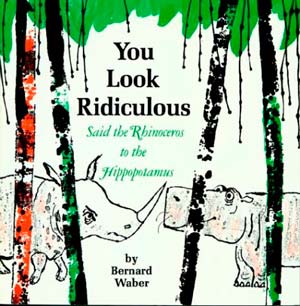 Children’s book author and Illustrator, Bernard Waber created many books for children including the Lyle the Crocodile series and Ira Sleeps Over. Another book, You Look Ridiculous Said the Rhinoceros to the Hippopotamus, is an old favorite that lends itself very well to introducing/reinforcing the SGM®/Braidy® List Map.
In this story, the hippopotamus is told by a series of other jungle animals that she looks ridiculous. Each animal then tells the hippopotamus that she needs features that he/she possess (examples include the leopard telling the hippo she needs spots and the giraffe telling the hippo she needs a long neck)...


Mondays with Maryellen
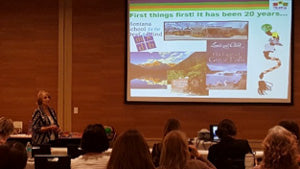 Hi Everyone! I’m sorry this post is a couple of days late – “Mondays with Maryellen” is on Wednesday this week ☺. We just returned from a whirlwind series of workshops in both San Antonio, Texas and Billings, Montana. We had great audiences, fabulous times with colleagues, and of course the San Antonio RiverWalk, the Alamo and the Big Sky Sunsets were marvelous to visit. Sheila’s 20-month-old daughter Casey and our friend Mary accompanied us on this trip — we’ve included some photos!
San Antonio was 95 degrees – wow! Billings was comfortable in the 70s. However, when we returned to Massachusetts, it was to a 19-degree morning! Alas, Fall, the prelude to snow in New England!
The trip to Billings and the return to the 19-degree morning prompt me to relate a new invitation we’ve received: A visit to Alaska upon the invitation of AKSHA—Alaska Speech Language and Hearing Association 2016 Convention next October...


A Trip Down Memory Lane: Feelings and Character Description Using a Classic Golden Book
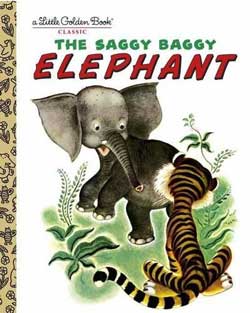 The Saggy Baggy Elephant, written by K. and V. Jackson, was first published in 1947 as part of many tales in the Little Golden Book series. I was recently reminded of this story when my neighbor’s grandson brought it to me to share. First published in 1942, Little Golden Books were created as an affordable choice of books that appealed to children. The books originally sold for 25 cents (www.randomhousekids.com/
goldenbooks) each. These books are still readily available to children, and, as of 2002, over 2 billion Little Golden Books were in print.
The following is The Saggy Baggy Elephant outlined as a basic complete episode...


Adobe Voice gives “Voice” to Narrative or Expository Language
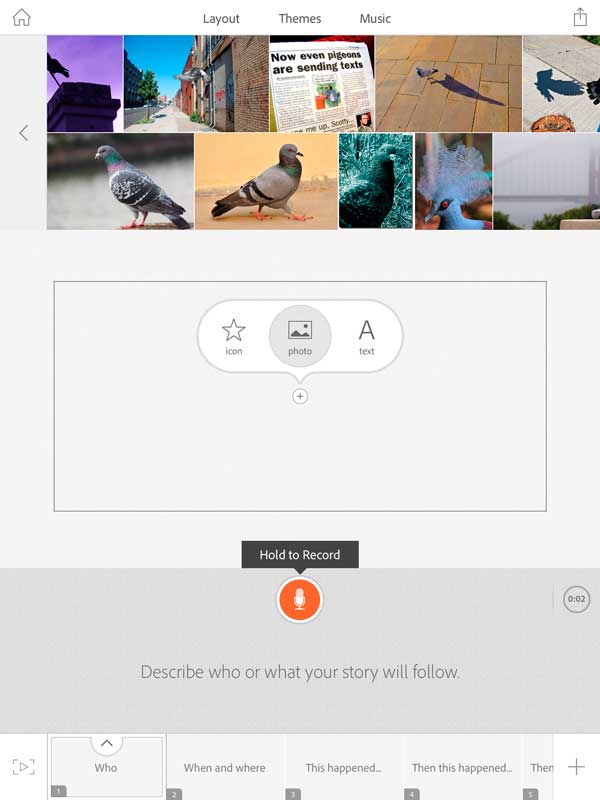 It’s Technology Tuesday, and this month we will cover a simple, free tool to practice combining visuals and oral narration to produce an engaging video! A main goal of using MindWing’s Story Grammar Marker® and ThemeMaker® tools is to provide structure for oral discourse. Narrative or expository maps provide a “plan” for the elements of discourse, along with key words to help students connect their thoughts when formulating a story or explanation. In this way, a culminating activity of using any language map can involve asking students to “connect the dots” in formulating a complete story or using expository language. Adobe Voice, a free, easy-to-use app, provides a fast and motivating way to do this!...


Writing: Expository/Informational Descriptive Map to Paragraphs
 Today, we will look at some writing samples using the topic of Koalas and ideas to scaffold the process from using the Character Descriptive Map to paragraphs. As stated previously, any book/resource that you use may be adapted to these activities.
We used several resources including:
We followed the same procedure as in the Armadillo and Cheetah lessons: reading short segments, making a list of facts, and placing each fact in the correct category (physical appearance, habitat, food and eating, young, special characteristics)...