


A Wonderful Wordless Video Series for Narrative Development
SLPs and teachers working in language intervention often turn to wordless picture books as a fun context to develop storytelling skills. Series such as Mercer Mayer’s “A Boy, a Dog, and a Frog...” tell stories through pictures and ask readers to tease out the story, inferring the important details and relying on characters’ facial expressions to glean important clues. Similarly popular are David Wiesner’s Tuesday and Sector 7, which depict narrative through fantastical illustrations, and Alexandra Day’s “Carl” series, in which a dog goes to great, un-dog-like lengths to care for his charge, a little girl named Madeleine. I have long been a fan of using such visual narrative materials with students, not only to develop storytelling skills...


Using QR Codes for Spooky Narrative Development

Over on my blog SpeechTechie this month, I am discussing in a series of posts the incredibly useful technique of using QR codes in language interventions. QR codes, which look like this (at left) were born in the world of marketing (you may have seen them on ads about town) but are making their way into educational settings as an attention-grabbing tool. QR codes can be created very easily and printed, then scanned with free apps available for your smartphone or iPad. When scanned, the app will show text that you entered or a link to a website...
Fantastic Narrative Intervention with Toontastic
 Recently in the Mindwing Blog I featured the Story Patch iPad app, which allows students to create stories according to provided structures or from scratch, resulting in a text and picture-based booklet.
I wanted to follow up that post with a different digital storytelling app that provides an easy means to create and publish dynamic animated stories with spoken audio and music! The app I speak of is Toontastic (an absolute BARGAIN at $1.99), whose creators at Launchpad toys have sought to bridge the gap created when students who primarily express themselves through play are suddenly expected to write stories (i.e. that gap we call “First Grade”). Toontastic uses the iPad’s multitouch interface...
Story Patch: A Great Context to Teach Narrative with Story Grammar Marker
There have been a number of apps for iOS (iPad/iPod/iPhone operating system) that have been released in recent months that seem like they were created for use with Story Grammar Marker! Digital Storytelling apps such as Story Patch allow children to create stories while having an emphasis on narrative structure, with choices about character, setting and actions. Students with language disorders will need assistance with organizing, expanding, and adding complexity to their narrative and sentence structure, and that is where you and the SGM come in!
In this video, I give a quick walkthrough of Story Patch (iPad only, currently only $.99- yes, that’s 99 CENTS) and its choices for story creation. You’ll see how its “Create a Story with Help” mode is a great opportunity...
The Zimmer Twins and Stepping Up Narrative Complexity!
I am going to open this post with a language sample obtained from a fifth grade student in 2006, an attempt to retell an episode of the series Full House.
And um something that happened was when this girl named Michelle and this guy Jesse, it was Michelle’s birthday. And Jesse and Michelle got stuck in a gas station and she missed her party.
And um they were there all day, but then finally it opened the next- no it opened a lot later. So um they went back to the house and they had their party and she got an elephant and she got to ride it and all her friends and she got, she felt better. And that’s it...


Dinosaurs, Narrative, and Flexible Thinking
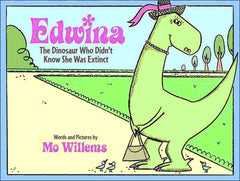
I always love finding resources that serve as a context for addressing many speech and language-related skills. The wonderful book Edwina — The Dinosaur Who Didn’t Know She was Extinct by Mo Willems is one of those resources; it can be used to target narrative and expository formulation, as well as social thinking skills in several areas.
To begin with, Edwina is a story that will engage and delight children from early to late elementary ages, beginning with its title and the name of the main character, Reginald Von Hoobie-Doobie. Reginald has a problem...