
Search
174 results found for "sean sweeney"


Tech Tuesday: AI writes stories!
 Artificial Intelligence (AI) has entered a new phase with the recent arrival of generative AI, which can be used to create content rather than just sort existing data. This has resulted in the release of tools such as ChatGPT, which is simple to use and query for all kinds of language content. Just log in with your Google account and you are good to go! Of course, with ChatGPT able to generate any kind of information and write in a wide variety of styles, there are concerns about its use as a workaround for schoolwork. Teachers do have tools to detect AI writing, and a specific SLP’s take is that this kind of AI clears the way for us to work on higher level skills. For now, it’s a good tool to explore. Consider the ways that ChatGPT specifically could be used to generate stories using specific Characters, Settings or Kick-Offs in order to emphasize story elements with Story Grammar Marker®. It also can be used to create text that corresponds to various expository text structures such as List, Sequence, and Description and thereby be used with ThemeMaker®’s Information structures and Maps...


Tech Tuesday: Make Simple Parallel Stories with Jamboard!
 from Google is a tool that was created “just in time” (in tech-talk) for the pandemic. Of course, these events thrust us into new ways of working with our students from a distance. Jamboard’s simple whiteboard features simplified remote, tech-based clinical interactions, such as solidifying ideas with pictures and making thinking visible with sticky notes. Jamboard was released in 2017 as a business-brainstorming tool and had started to make its way into educational circles more widely when the unthinkable happened: schools and clinical settings needed to shut down. Throughout the pandemic, it was an invaluable tool, one which I wrote about here in conjunction with the use of MindWing’s Digital Icons. But like some emergency practices, it has continued to be extremely useful. See the linked post above for some nitty-gritty how-tos on using Jamboard. In this post we are going to focus on a specific application of creating parallel stories. The practice of using picture books in speech-language and literacy interventions is well established, as it can provide a context for teaching narrative structure (with Story Grammar Marker® of course) and microstructure such as syntax and vocabulary targets...


Tech Tuesday: Story-Form Directions and Play!
 Being told what to do is often no fun. But for many of us targeting language development objectives, we have to deal with our students’ potentially low scores on assessments such as the CELF-5s Following Directions subtest. Key to success on activities such as these are student’s listening skills and understanding of concepts related to time, space, number, and sequence, among others. The good news is that these concepts are everywhere and can be targeted through stories and play! One way I have been approaching this is through the Toca Life: World app, previously discussed here. The app is available for multiple platforms as you can see, and you can either purchase individual “Settings” (e.g. Toca Life: Vacation, which I like to refer to with colleagues as The White Lotus), or connect purchased apps through the World app. The World app also has mini-settings you can purchase for short money, for example, a ski resort. I have been using the book Where’s Walrus? by Stephen Savage with students recently (video here) (recall: using picture books on YouTube can work wonderfully with heavy use of the pause button)...


Tech Tuesday: Teaching through the Thought Bubble
 Picture books are one of our best and most engaging narrative teaching tools, and I love especially when I find a series to share with my students—and you! Series books allow for special opportunities to establish flow (both contextual and psychological) with similar character behaviors, narrative patterns, and themes. I have long been an admirer of author/illustrator Jon Klassen due to the power of his minimalist illustrations, which are beautiful but also witty, and establish character emotion primarily through exaggerated eye expressions. Recently I discovered he had illustrated a trilogy with Mac Burnett now called the Shape Trilogy, consisting of (in this order, which actually is important), Triangle, Square, and Circle. In these books, we can follow the antics of several shape characters as they interact with friends.


Tech Tuesday: Internalizing Icons!
 Story Grammar Marker® provides visual support for understanding and forming narrative, but part of its work depends on students ascribing meaning to its icons. Helping students internalize these visuals, their connections and meanings can take some review, and the more fun, the better! Here are a few tech-infused ways to drill-play the SGM® icons! Use a Slideshow! Google Slides can be a great way to make a digital “manipulative” for review. Pick a personal narrative or reviewed story to talk through, then use the Slideshow mode as a “quiz” on the icons alone or linked to contextualized story elements (e.g. “Kick-Off- the Bear’s kick-off was that someone stole his hat!”)...


Tech Tuesday/Summer Study Series: Language Disorder and Emotional Regulation
It’s hard to believe that this is the last entry in our 2022 Summer Study Series as we are entering the final act of the summer. For that matter, consider all we do to regulate ourselves around these transitions (Lifehacker article): being able to label how it makes us feel, and applying thinking tools and activities to help ourselves adjust. Like all humans, we have varying degrees of success in navigating these emotional waters, which is the subject of this month’s post. The article “A Multimodal Comparison of Emotion Categorization Abilities in Children With Developmental Language Disorder” (Bahn, Vesker, Schwarzer & Kauschke, 2021)...


Tech Tuesday/Summer Study Series: A Continuum of Explicit to Implicit Learning
In this penultimate entry in the 2022 Summer Study Series, we’ll explore how the use of tools such as Story Grammar Marker® can gibe with models of instruction and learning. Baron and Yarbel’s (2022, brand new!) An Implicit–Explicit Framework for Intervention Methods in Developmental Language Disorder is a tutorial describing theories of learning related to language disorder and associated modes of intervention. This article explores a neurologically based understanding of how we might learn explicitly: consciously trying to memorize information, facts, or apply skills, vs. implicitly: picking something up naturalistically and without really trying. These ways of learning can inform how we use tools such as SGM® particularly with young children with language disorders...


Tech Tuesday/Summer Study Series: The Moral of the Story is…
 As someone who loves themes and context, I was thrilled to find a particular study on assessment and intervention with FABLES to include as this entry in the 2022 Summer Study Series! This resource made me think back to last year’s discussion of using moral dilemmas in narrative language and social cognitive therapy activities. This post includes the advantage of having many adaptable materials to offer you! Specifically, we are talking about Philosophy for Adolescents: Using Fables to Support Critical Thinking and Advanced Language Skills (Nippold and Marr, 2022), an extensive article describing the authors’ work in assessing and intervening in language and critical thinking skills through fables...


Tech Tuesday/Summer Study Series: Narrative Meta-Analysis!
 With much of the USA wrapping up the 2021-22 school year, it’s time to embark on another summer study series. Naturally, each post will have a tech tie-in with a practical resource as well. First up, I was super excited to tell Maryellen and Sheila about a meta-analysis on narrative language interventions from October 2021 and have been eager to write about it here. A meta-analysis is considered among the highest levels of evidence and is a study of studies so to speak, applying criteria to include research on a topic and determining effect sizes of interventions. The study in question, Interventions Designed to Improve Narrative Language in School-Age Children: A Systematic Review With Meta-Analyses (Pico, Prahl, Biel, Peterson, Biel, Woods & Contesse) was published in ASHA’s Language, Speech and Hearing Services in Schools and is therefore available to all ASHA members, or ask your friendly SLP for a copy...


Tech Tuesday: Mix it Up!
 Though it should be a 12-month goal, this April—during Autism Acceptance Month—it’s important for us to be making strides toward considering what and how our students want to learn. Doing so gears us toward aligning with the client values aspect of Evidence-Based Practice and with implementing therapies that are responsive to neurodiversity. In this way, it’s helpful to consider the flexible aspects of tools such as Story Grammar Marker®, so that we can show and affirm with clients that there are many ways to express ourselves. I recently was completing a lesson and activity with a group of middle school students about a topic I consider to be critically important right now: RESILIENCE. Resilience is in many ways wrapped up in narrative language because of the role of how we relate our own experiences (stories) to ourselves...


Tech Tuesday: Make a Vocabulary “Story”
 Hello! You are here because stories are fun and engaging, right? Well, they also are strategic for teaching and learning. The National Council of Teachers of English(NCTE) states that story forms can aid in memory and recall across the curriculum: “Listeners encounter both familiar and new language patterns through story. They learn new words or new contexts for already familiar words.” It just makes sense! The context, engagement and emotional activation of a story can assist in any vocabulary related to that story. In this post, I’ll be detailing a number of tech- and non-tech resources for using vocabulary “stories.” Check out Beck, McKeowan, and Kucan’s Bringing Words to Life. This seminal vocabulary-teaching text discusses the concept of Tier 2 vocabulary words (robust words which link to concepts kids understand, such as the word final), and teaching them through context, kid-friendly definitions and word play.


Tech Tuesday: “Storyboard That!”
 Among the tech resources that can be helpful in narrative intervention are those that let you make your own story. Content creation apps and websites, often called “digital storytelling” tools (search Pinterest for many examples in this genre), provide great contexts for speech, language and literacy skill development for their ability to visualize story elements in cartoons or images. Digital storytelling tools can be employed in parallel with Story Grammar Marker® manipulatives, icons, and maps in a variety of ways: You make it: Create a product that you can “unpack” the story elements of with students, with SGM® playing a key scaffolding role, of course. We make it: Co-create with students by allowing them to make choices to construct a story, with you handling parts or all of the actual tapping or clicking to move things along. They make it: Often facilitated with you providing a model...


Tech Tuesday: Choose Your Own Prob-Narra-Ventures
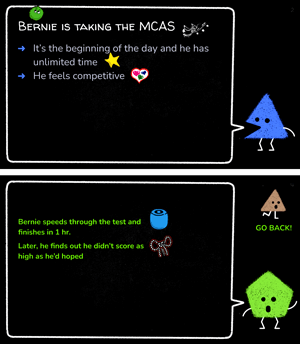 We’ve spoken in this space before (blog link) about the links between narrative language and problem solving that can be scaffolded through the use of Story Grammar Marker® and its relevant icons, particularly the digital kit. Moveable icons are very useful in guiding thinking and discussion when bringing students back to a relevant detail (or story element) that they may not have been considering. See also the work of Westby and Noel (2014) on the connections between story and problem solving. Recently I have been working with several students on test-taking skills and strategies, a process in which it is helpful to address the thought processes, self-talk, as well as social cognition and self-regulation that underlie this situation...


Tech Tuesday: Finding the “Story” in Cooperative Games
In a little deviation from what might be considered “high” tech this month, I’ve recently been thinking a lot about the role of play in language  interventions. Play is closely connected to narrative, as we often use story components to structure our play. I recently presented at ASHA Convention providing a “Play on Words” (click here for the handouts), and discussed a variety of playful contexts that can be used to target language (including narrative) and social learning. In particular, cooperative games with a shared goal and no real “winner”— except the group—can be used to target many communication skills...


Tech Tuesday: More Spooky Stories!
 Halloween is always a holiday that can be leveraged for engagement (and stories!) with our students. We hope you will add these three resources to your list to “harvest” annually! Through the pandemic telepractice-fest and beyond, I have enjoyed capitalizing on the trend of escape rooms for intervention activities. They make a great collaborative activity and encourage students to “think with their eyes” (ala Social Thinking®) as they look for clues. Escape “rooms” from HoodaMath contain a brief “story” introduction--why you are trapped there, a Kick-Off, and what you need to plan to do to get out! And what is an escape activity but the exploration of a Setting? Use MindWing’s Setting Map to teach the language underpinnings of describing a setting. In particular, escape games are great for helping students to label the parts of a larger setting...


Tech Tuesday: Flexible Icons!
 MindWing’s Digital Icons were first created in the wake of the Covid-19 emergency in order to offer access to tech-based material creation while many professionals were struggling to implement teletherapy as best we could. As you may know, the icon sets offer easy copying and pasting of the icons (including Story Grammar Marker®, Braidy the StoryBraid® and Thememaker®) into various “blank slate” resources. This allows us to use word processors (Google Docs/MS Word), presentation tools (Google Slides/PowerPoint) or whiteboard software (Smart Notebook) as powerful narrative and expository teaching tools.


Tech Tuesday: Summer Study Series #4, Be Principled!
 In this, our last entry in 2021’s Summer Study Series, we’ll review a recent article from leaders in the field who present a very helpful set of 10 principles for narrative intervention that will guide you in this new school year. Additionally, several strategies for leveraging technology will also be described, as we can consider tech a useful tool, however your service delivery evolves in this unfortunately still-weird educational situation. Spencer and Peterson (2020) detail narrative intervention principles and practice tips in their ASHA-accessible article “Narrative Intervention: Principles to Practice.” I love the trend of incorporating the ever-readable web “listicle” as an element of our research literature...


Tech Tuesday: Summer Study Series #3, Consider the Functional
In July’s entry for 2021’s Summer Study Series, we’ll be looking at the critical overlap between narrative and expository language and our students’ access to the academic curriculum. Meaux and Norris (2018) tackle this topic in a tutorial for Language, Speech and Hearing Services in Schools entitled “Curriculum-Based Language Interventions: What, Who, Why, Where, and How?” I have always appreciated ASHA publications’ “tutorial” articles as I have found them to provide the most functional and practical information to be useful in interventions. The other “functional” consideration with this article is that including a focus on curriculum has always seemed natural to me. There is so much inherent language in school curricula and, from a linguistic perspective, this potential gap in comprehension and expression is why students receive our services...


Tech Tuesday: Summer Study Series #2, Stories of a School Year Like No Other
 Continuing here with 2021’s Summer Study Series, this post will be a little different. Rather than focusing on analysis of one article for further learning, I’d like to point you in the direction of a few resources related to a theme: mental health and recovery from the COVID-19 pandemic. We’ve all heard and experienced it in some way, at this point almost a cliché; it was a school year like no other. Loss of a feeling of safety, of connection, of experiences, of freedoms, perhaps of health or people in our lives, these all pervade our memories of the past year. I’m of the mindset that every little bit of processing is potentially helpful. However, you may feel uncomfortable or unequipped to go into these topics in personal narrative with your students. For some support, I’d like to point you in a few directions...


Tech Tuesday: Summer Study Series #1, Morality as Language?


Tech Tuesday: More Jamboard and Mixed Methodologies
 Over the past months, I have been working with students online and finding new ways to use this Jamboard tool...the sky’s the limit! One effective way is to integrate methodologies like Story Grammar Marker® into the use of Jamboard as a visual support to elicit and scaffold language. Audiobooks from Epic! Audiobooks for Kids can be chosen for short segments or chapters that make for a zone-appropriate lesson blending auditory comprehension with narrative language intervention. You may not be willing to go to bathroom-humor-lengths to engage your students at this point, but I am! So, since they asked for Captain Underpants (Dav Pilkey), I checked it out, and delivered!...


Tech Tuesday: Technology Brings Stories to “Give”
 The “Give a Story to Get a Story” technique is one we all know makes sense. We’ve seen what often happens when we ask students to produce a narrative out of the blue. More often than not, we are rewarded with a blank stare! The use of the “Conversational Map,” the formal name for this technique, was first described by Peterson and McCabe (1983) and, in web-accessible articles, adapted by McCabe and Rollins (1994) and Hadley (1998). In my experience, these articles hit on principles applicable when working with preschool, through adult clients, who can all benefit from language scaffolding...


Tech Tuesday: “Jam” with SGM®
 Get ready to Jam! This past year, Google introduced the interactive and collaborative tool Jamboard, which could not have come at a better time given the pandemic and our need to engage students via distance learning. Jamboard allows for quick and easy co-creation of visuals in a shared space via addition of images, sketches, text boxes and post-its. Therefore, it is a great venue for making interactive scenes, brainstorming, and generating language on graphic organizers. To access Jamboard, follow the steps you would to get started with any Google tool: go to the “waffle” in the upper right corner of a Google space such as Gmail or Drive, and select Jamboard...


Tech Tuesday: “Woke” Stories, Using the Critical Thinking Triangle® with Current Events
 This fall I have had the great pleasure of working with a student who is very engaged in teletherapy and has a special interest in topics related to social justice. His “woke” nature has served him in keeping informed about the pandemic and stories related to the Black Lives Matter movement, but like many of our students, he can miss important elements of these narrative events. ASHA outlines that incorporating Client Values into treatment is an important component of Evidence-Based Practice (EBP). This is defined as “the unique set of personal and cultural circumstances, values, priorities, and expectations identified by your client and their caregivers.” This aspect, as well as the importance of engaging textual contexts and targeting narrative for students with ASD, led me to conduct a weekly current events activity through teletherapy for his sessions...


Tech Tuesday: Gratitude is a Story
 The practice of gratitude is one that research suggests can be helpful psychologically all year round, so my hope is that this post will be useful to you in many days beyond Thanksgiving. However, when you think about it, gratitude is based in narrative, as a thought/emotion we have in response to life events. Culatta and Westby (2016), in a tutorial entitled “Telling Tales,” suggest that intervention to improve narrative language including emotional and theory of mind content should “focus on emotion and character traits that cross events.” For this and other reasons, particularly “in these difficult times,” we would do well to cultivate expressions of gratitude in interventions across the year and in varied contexts. Here are some resources to help you promote gratitude along with narrative and expository language...


Tech Tuesday: The Very COVID-Relevant SGM®
 As a (mostly entirely) telepracticing Speech-Language Pathologist during these weird times, I have found fostering narrative language in my students to be an even more critical intervention area than before. From providing opportunities to help students escape into stories, to helping them share their thoughts and feelings on school and home, current events and relationships, the Story Grammar Marker® has been an essential tool in therapy. In this post, I will describe some tech-based applications of SGM® for you to consider during the pandemic. Even with, and perhaps, because of the prevalence of remote learning, students are feeling isolated and likely having fewer opportunities to tell their stories and gain connections with others. In group therapy, we spend time letting conversation “breathe” and scaffolding connections. One way I have worked on this is to blend the new Conversation Paths product by Dr. Anna Vagin, CCC-SLP with Story Grammar Marker® Icons to tackle multiple narrative and social-cognitive goals. Conversation Paths is a pack of editable conversation-scaffolding visuals (PowerPoint) targeting the building blocks of conversation: “4 Starters” (initiation strategies), comments, questions, and others.


Tech Tuesday: Using and Annotating MindWing’s Virtual Posters
 In this post, we’ll describe how to use MindWing’s NEW Virtual Posters product in distance learning sessions, and also how to annotate them for narrative scaffolding with students. The Virtual Posters provide a range of visuals that are easily added to Zoom or Microsoft Teams sessions (currently not Google Meet) and provide a reference for narrative/expository text and social pragmatics instruction. First of all, it is important to know how to add these visuals, which are JPEG image files, to platforms such as Zoom, in order to use them as virtual backgrounds during a session...


Tech Tuesday: Summer Study Series and “What Does It Mean to Be Social?”
 For our last 😢entry in our “Summer Study Series” for 2020, we look at a perspective on social cognition with a twist: how are children with significant speech sound disorders, such as apraxia of speech, impacted within the sequence of developing social competencies? This article, What Does It Mean to Be Social? Defining the Social Landscape for Children With Childhood Apraxia of Speech, is provided by Nancy Tarshis, Michelle Garcia Winner, and Pamela Crooke (2020) and was released within ASHA’s Perspectives (Special Interest Group 2) journal available to anyone with a SIG membership in any specialty. For others, the article is behind a paywall, so I hope this review at least will be helpful...


Tech Tuesday: Summer Study Series on an RCT of Narrative Intervention for Adolescents
We look at an exciting piece of research from last summer (July/August 2019), Improving storytelling and vocabulary in secondary school students with language disorder: a randomized controlled trial* (full article available at link). In this article, Joffe, Rixton and Hulme describe a randomized controlled trial (RCT) involving both narrative and vocabulary intervention for secondary students in the UK. It is notable because RCTs in language intervention are relatively rare, and considered a high level of evidence. ASHA, on a scale of evidence quality, rates “well designed randomized controlled trials” as level 1b, 2nd on a 6-point scale of evidence; these are research studies in which intervention groups are compared to a control group in which no intervention was provided. Additionally, interventions for adolescents with persistent language problems are less researched, so this study is an important one!...


Tech Tuesday: Return of the Summer Study Series!
 For the past several years in this space we have presented a “Summer Study Series” highlighting peer-reviewed articles and research relevant to narrative and expository assessment and intervention. For 2020, we begin with A Systematic Review of Academic Discourse Interventions for School-Aged Children With Language-Related Learning Disabilities (Peterson, Fox & Israelsen, 2020). Systematic reviews are a higher tier of research applying selection criteria and metrics to determine effect sizes of studies of particular types of interventions. In other words, a study of studies specific to narrative and expository (more the latter) discourse...


Tech Tuesday: Placing Expository Structures/Icons in Context
 MindWing’s icons for narrative and expository language can make conversation about any TOPIC a strategic and scaffolded one. Last month I recorded a free webinar with Maryellen (Technology Tools to Engage Children in Science & Social Studies During Distance Learning Sessions) on expository text structures (ThemeMaker®) and using MindWing’s icons in context with technology resources. In this post, I’ll be giving some examples of expository-embedded resources online that can be used in teletherapy sessions. By expository-embedded, I mean resources that don’t necessarily say one, another, also, or first, then next, but can be used to form conversations and reviews with structures like List and Sequence. Take for example, Google Earth. This now-web-based interactive globe allows you to simply search and navigate in order to provide tours, and what is a tour but a LIST (or SEQUENCE) of places within a main idea or overall location...


Tech Tuesday: Basics of Using MindWing’s Digital Icons

MindWing has made its digital icons available at low cost to assist us as we are providing distance learning and teletherapy during this COVID-19 crisis (surely one of the biggest common kick-offs we have experienced). In this post, I’ll be outlining some what-tos and how-tos with the icons; if you’d like a longer visual overview, I recorded a webinar (Intersecting Story Grammar Marker® with Technology and Telepractice: Distance Learning During this COVID-19 Crisis and Beyond) with Maryellen on April 1, 2020 and the recording is available for free on the site. The Digital Icons downloadable is a PowerPoint (PPT) file that can also be opened in Apple (Mac)’s free Keynote application or uploaded to Google Drive and opened with Google Slides. PPT files open automatically in Keynote, but let’s tackle that Google part first...


Tech Tuesday: ASHA Convention Wrap-up, Part 2
 In last month’s post (ASHA Wrap-Up, Part 1), I outlined one session from Orlando’s 2019 ASHA Convention that I was involved in, and promised a part 2! For this post, I am going to focus on resources I presented in an additional installment of “Pairing Picture Books and Apps for Contextualized Language Intervention,” a session I have been privileged to present over the last several years, with varying themes. In this session, given the proximity to Epcot, I thought it would be fun to highlight the ways that picture books and apps can be used to “Show Them the World (Knowledge),” meaning work in context to develop both Social Studies and general world or semantic knowledge. In all of my sessions on this topic, I have always emphasized the potential for both books and apps to provide context to develop both story grammar and expository text structure, modeling of course, with Story Grammar Marker® and ThemeMaker® tools and visual graphic organizers. Both macrostructure and microstructure can be emphasized when reviewing the story or information presented in a book or app, along with other skills...


Tech Tuesday: ASHA Convention Wrap-up, Part 1
 This year brought those of the speech-language pathologist ilk to Orlando, which I have come to think of as the land of simulated Character and Setting. Inside the more sedate but still stimulating conference halls, MindWing’s tools were shared by a number of presenters including me! In Developing Expressive Language In Preschoolers: Strategies to Increase Utterance Length and Complexity (Mentis, Howland, Graham), the authors described their integration of Braidy the StoryBraid® into a language and literacy program for preschoolers, providing graduate student clinicians with wonderful experience in targeting language in the context of stories and play. The presenters recommended a number of books used within their program, moving from emphasis on simple to more complex story grammar and microstructure...


Tech Tuesday: More on Memes (Think Halloween!)
 Today’s kids really like memes, digesting them from internet spaces we are too cool to inhabit! Therefore, they serve as a textual or language-infused genre that we can exploit for our students’ engagement. Often a meme suggests some element of a narrative that serves to facilitate a discussion or mapping of other elements. We can compare and contrast these narrative forms with exposition, or explaining ideas (see Thememaker®). When critiquing narrative works such as movies, it’s always felt to be a no-no to have too much exposition, or telling (not showing), such as when a character suddenly explains the mystery inherent to a plot...


Tech Tuesday: Telling Tales at Varying Developmental Levels
 The practice of providing model narratives in order to scaffold personal narratives from students is one that is supported in our literature. Pamela Hadley (1998) describes conversational mapping, or “give a story to get a story,” as critical in language sampling, and these principles can be extended to intervention activities. Westby and Culatta (2016) suggest similar procedures: “Clinicians can model the telling of event narratives and ask children to relate their own experience about a similar event. One clinician told of a time when she did not close the door on her hamster's cage, and the hamster escaped and was never found. The telling of that experience elicited a child's story about a time when he had pet crickets in a cricket cage and the family cat got into the cage and ate the crickets.” We should remember that not every model needs to be a complete episode, though I realized after a recent trip to Utah’s National Parks that I had one ready-to-go. Additionally, this model also demonstrates the synchrony between Story Grammar Marker® and Zones of Regulation®.


Tech Tuesday/Summer Study Series: Narrative and Autism Spectrum Disorder
 I am frequently asked to conduct evaluations encompassing social cognition and pragmatic language and always find it extremely valuable to include a detailed assessment of narrative language. However, in doing so, and having reviewed previous assessments of these students, I often find that I am like a newcomer to a desert landmark, standing there saying “Hey, look at this…?” Why haven’t the examiners before me documented and then suggested interventions around these inevitably present narrative language issues?...


Tech Tuesday/Summer Study Series: Because and So Science
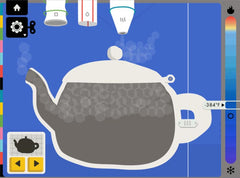 For July’s entry in the “Summer Study Series,” we’ll be looking at some cool connections to the science curriculum in addressing the macrostructure and microstructure of language. Our posts this summer are summarizing recent research related to narrative and expository language and Story Grammar Marker®/ThemeMaker® to give you some scientific thought for summer. To set the tone, there are some natural connections between the SGM® and ThemeMaker® methodologies and using science content with students. Narrative and expository elements give a framework for summarizing story and information, elaborating, focusing on main ideas and reducing the load on working memory by providing a scaffolded structure. The scientific method itself, moving from observation (Character/Setting), planning and hypothesizing, following experimental steps, and developing a conclusion, can be reframed using the Story Grammar Marker® as is demonstrated in the original SGM® manual...


Tech Tuesday/Summer Study Series: Fostering Rhetorical Competence in Expository Text Interventions
 This summer we are bringing back the “Summer Study Series!” This series of posts is providing summaries of recent research related to narrative and expository language and Story Grammar Marker®/ThemeMaker® in order to expand your toolkit and library of evidence-based practice information for September. So, to our study for the month! We invite you to Spain, this time, for some work clearly relevant in English as well, from García, Sánchez, Cain & Montoya (2019), published in the journal Learning and Individual Differences. Their “Cross-sectional study of the contribution of rhetorical competence to children's expository texts comprehension between third- and sixth-grade” looked at rhetorical competence (RC), or knowledge and understanding of certain text cues within expository texts and its interaction with reading comprehension...


Tech Tuesday/Summer Study Series: An Evidence-Based Approach to Building Inferential Skills through Narrative Texts

This summer we are bringing back the “Summer Study Series!” This series of posts will provide overviews of recent research related to narrative language and Story Grammar Marker® in order to give you “food for thought” to digest relevant to clinical techniques in the upcoming school year. I was quite excited to discover that a recent study on developing inferential language has a direct connection to SGM®, as MindWing’s icons were used in story mapping activities included as part of the studied intervention. Dawes, Leitao, Claessen and Kane (2019), developed and studied a specific intervention sequence for improving inferencing in students with Developmental Language Disorder (DVD). Some summarized points from the study are as follows...


Tech Tuesday: Five FREE Current Sources of Expository Text
 When working with students on comprehending expository text, we can often capitalize on their interests for motivation. However, expository sources lack the draw of narrative, so it can be helpful to use technology to add engagement. In this post we’ll update you on five places you can find free expository text material for mapping with ThemeMaker® maps for List, Sequence, Description, Compare-Contrast, Problem-Solution or other associated graphic organizers...


Tech Tuesday: The Story of an Argument and Perspective
 No need to break out the popcorn, we’re not talking about the argumentative kind of argument! I have been working with a high school student over the course of the past year who has particular difficulties in comprehension and discourse formulation. His school has quite a challenging program, and each session brings to the table a contextual assignment in which organizational strategies can be identified for him to apply. Fortunately, he is very engaged in the process and can always identify a task for which he needs help. This past week, he was working on constructing an outline for a debate argument, and I immediately thought of the Persuade organizer from MindWing’s Thememaker® tool for understanding and organizing expository language...


Tech Tuesday: Supporting Narrative Development and Emotional Vocabulary

Illustration by Ariel Davis for NPR
I’m a big NPR person. It’s a great resource for listening, and for narrative! This past month I was intrigued by a feature on “EMOTIONAL GRANULARITY”—being able to name or describe your emotions more specifically. The author described an increase in stress in his life being alleviated by his working on “learning more emotion words and emotion concepts from one’s culture.” There was research to support his assertion that this self-identification was of help; according to Kashdan, Barrett, and McKnight (2015), “evidence suggests that interventions designed to improve emotion differentiation can both reduce psychological problems and increase various strands of well-being.” We can reframe this information in the light of what we might usually address as speech-language pathologists and literacy interventionists...


Tech Tuesday: ASHA Beantown Wrap-up, Part 2: Telepractice
 First of all, you may wonder, what is telepractice? And, if you are not so interested in the answer, this post will still have some tech-related ideas for you to apply in your “in-person” therapies. To quote ASHA’s resource page on telepractice: “Telepractice is the application of telecommunications technology to the delivery of speech language pathology and audiology professional services at a distance by linking clinician to client or clinician to clinician for assessment, intervention, and/or consultation.” All of the exact same principles and practices of intervention via in-person therapies apply to telepractice, just the method of delivery is different. Telepractice is often conducted via a secure web portal such as Zoom, allowing clinicians and clients on the other side to communicate via microphone and webcam, and using visual and interactive tools to conduct activities (e.g., screensharing, giving the client control of the screen for clicking and dragging)...


Tech Tuesday: ASHA Beantown Wrap-Up, Part 1
 This past week featured the American Speech-Language Hearing Association’s annual national convention in our home state (and my home city of Boston)! MindWing presented and exhibited at the convention and I was proud to be part of two presentations that incorporated MindWing’s tools with context-setting resources including both technology and picture books. I was thrilled to present another edition of an oral seminar describing the helpful pairing of picture books and apps for contextualized language intervention. As this year’s ASHA theme focused on evolution and innovation within the field of speech-language pathology, this presentation centered around pairings that aligned with social studies and science topics (Boston also is a “Hub” of both disciplines). Some of the background within this presentation centered on why SLPs and literacy interventionists might seek to incorporate social studies and science topics in our work...


Tech Tuesday: Google’s Geo-Tools Show More than Setting!
 Following up on last month’s Tech Tuesday post describing some narrative and expository teaching tools within Google’s G-Suite, this month we’ll look at some Google resources to visualize setting (and more)! Google Earth has long been a great tool for language development, as it is a searchable, interactive globe allowing you to zoom into an aerial (3D) image of any location, as well as offering Street View interactive imagery and text descriptions. Google Earth previously existed as a complicated downloadable application but now is available as a web version in the Chrome browser, as well as a simplified free iPad app...
Tech Tuesday: Back to School Part 3—Considering Narrative Language Applications of Google Tools
 Let’s consider some uses of one of the most commonly applied EdTech Tools: Google’s Apps or “G Suite.” G Suite has become a go-to within schools for a number of reasons, including its price (free), versatility and ease of use of productivity tools such as Docs and Slides, word processing and presentation creators, respectively. Additionally, G Suite is easily used on inexpensive Chromebook computers, which allow schools to put technology in a wide range of hands across the day. Chromebooks are easy to manage and essentially only run a Chrome web browser, making them a good match for use with the web-based G Suite. SLPs and literacy interventionists may see G Suite as too basic to consider for storytelling and narrative language opportunities. However, the opportunities to use images, drawings, and other visual supports are varied, easy to use, and worth considering—particularly when seeking to implement MindWing’s methodologies such as Story Grammar Marker® and ThemeMaker® within classroom settings, G Suite features will make it easy for students to apply what they are learning about narrative and expository language!...


Tech Tuesday: Back to School Part 2—Five Great Resources for Demonstrating Narrative and Informational Expression
 Using interactive apps and websites, we can help students deconstruct discourse and see its essential parts. However, technology can also provide a space—a blank slate, so to speak—that we can use to help students use narrative and expository elements and icons to build language through engaging mini-projects using apps for creation. The realm of “digital storytelling” has expanded, and at the same time became more simplified with the arrival of easy-to-use apps. iPad and Android “creation” apps (oft referred to as apps that allow students to “show what they know”) can be used to make picture collages, books, animations or videos that tell a story or give information...